

The United Kingdom remains one of the world’s most prestigious destinations for higher education, hosting over 600,000 international students annually. However, behind the glossy brochures of the Russell Group and the historic spires of Oxford or Edinburgh lies a rigorous, often overwhelming reality: the UK academic workload.
For students arriving from different educational cultures, the shift to “independent learning”—a hallmark of British universities—can be a profound shock to the system. Managing this stress isn’t just about working harder; it’s about navigating a complex ecosystem of deadlines, research standards, and personal well-being.
Understanding the “Independent Learning” Culture
In many global education systems, students are guided closely by instructors with frequent testing. In the UK, the focus shifts to self-directed study. A typical undergraduate may only have 12–15 “contact hours” per week, but is expected to perform 25–30 hours of independent research.
This lack of rigid structure is where stress begins. Without a set schedule, many international students fall into the “procrastination-panic” cycle.
The Pillars of UK Academic Stress
- The Critical Analysis Gap: British markers value “criticality” over “repetition.” Simply memorizing facts will not earn a First-class mark; students must argue, deconstruct, and synthesize.
- The OSCOLA/Harvard Hurdle: Referencing standards in the UK are notoriously strict. A single misplaced comma in a bibliography can lead to “unintentional plagiarism” flags.
- Language Synthesis: For those speaking English as a second language, the cognitive load of translating complex academic theories while maintaining perfect syntax is exhausting.
Practical Strategies for Workload Management
1. The 48-Hour “Internal” Deadline
The most successful students in the UK do not aim for the university deadline. They set an internal deadline 48 hours prior. This allows for a “buffer zone” to handle technical glitches or last-minute proofreading.
2. Strategic Outsourcing and Support
There is a growing realization that “doing it all alone” is a myth. High-achieving students often utilize a mix of university writing centers and external academic mentors. During peak assessment periods (usually January and May), the pressure can reach a breaking point where the most logical step is to seek expert intervention.
When a student feels they are drowning in complex modules, they often look for professional services to help me do my assignment so they can focus on their mental health or part-time work commitments. This isn’t about avoiding work; it’s about resource management. By using a service to help me do my assignment, a student can receive a model of excellence to follow, ensuring their own final submission meets the high linguistic standards of a UK marker.
3. The Pomodoro Technique (UK Context)
Focusing for four hours straight is impossible. The UK student community has widely adopted the Pomodoro technique—25 minutes of intense focus followed by a 5-minute break. In the UK, this is often paired with “Body Doubling,” where students sit in a library (like the British Library or a campus hub) and work silently together to maintain accountability.
The Role of Mental Health in Academic Success
The Office for Students (OfS) has highlighted that international students are less likely to access traditional mental health services. This is often compounded when the coursework itself is heavy. For instance, when tackling complex assignments, knowing how to write an essay on mental health awareness among students is a specific skill that requires both academic precision and personal resilience.
Signs of Academic Burnout:
- Avolition: An inability to start even simple tasks.
- Fragmented Sleep: Waking up thinking about citations or word counts.
- Social Withdrawal: Skipping “societies” or “pub nights”—which are essential for cultural integration—to stay in the library.
Dealing with the “Plagiarism” Anxiety
The UK’s use of Turnitin is among the most sophisticated in the world. For international students, the fear of a “red flag” is a constant source of stress. To mitigate this:
- Use Draft Coaches: Most UK universities provide a “practice” Turnitin upload. Use it.
- Human Feedback over AI: While AI tools like ChatGPT are tempting, they often produce generic “Americanized” English that stands out to UK professors. Professional academic mentors provide a more “human” and nuanced approach that aligns with British marking criteria.
Comparative Analysis: UK vs. International Workload Expectations
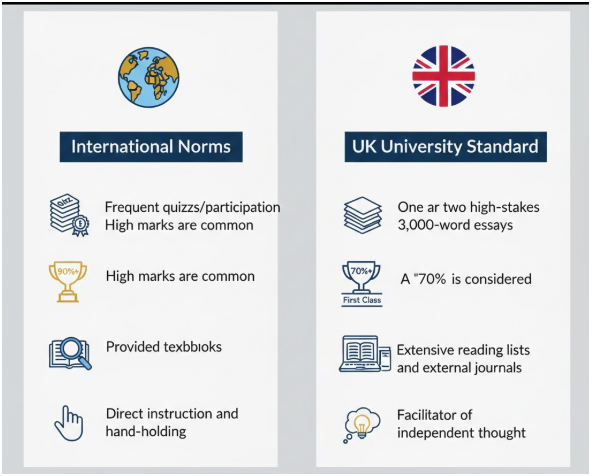
| Factor | International Norms (Many Regions) | UK University Standard |
| Assessment Type | Frequent quizzes/participation. | One or two high-stakes 3,000-word essays. |
| Grading | High marks (90%+) are common. | A “70%” (First Class) is considered elite. |
| Role of Tutor | Direct instruction and “hand-holding.” | Facilitator of independent thought. |
| Research | Provided textbooks. | Extensive reading lists and external journals. |
Integrating into the British Academic Community
Stress is often a symptom of isolation. International students who join Academic Societies or Student Unions often find that their peers are struggling with the same “Help me do my assignment” internal panic. Sharing these burdens reduces the cortisol levels associated with isolation.
Moreover, engaging with the Personal Tutor system is vital. Every UK student is assigned a faculty member for pastoral care. Being honest with a tutor about being overwhelmed is not a sign of weakness; in the UK, it is seen as a sign of professional maturity.
Conclusion: Balancing the Scales
Navigating a UK degree is a marathon, not a sprint. The “Evolution of Essay Writing” mentioned in modern discourse isn’t just about technology—it’s about the evolution of the student as a manager.
About The Author
Ruby Walker is an academic success specialist and a lead writer at MyAssignmentHelp. She specializes in UK pedagogy, critical analysis, and student well-being. Ruby’s mission is to empower students by providing them with the expert mentorship required to overcome academic burnout and achieve first-class results.