
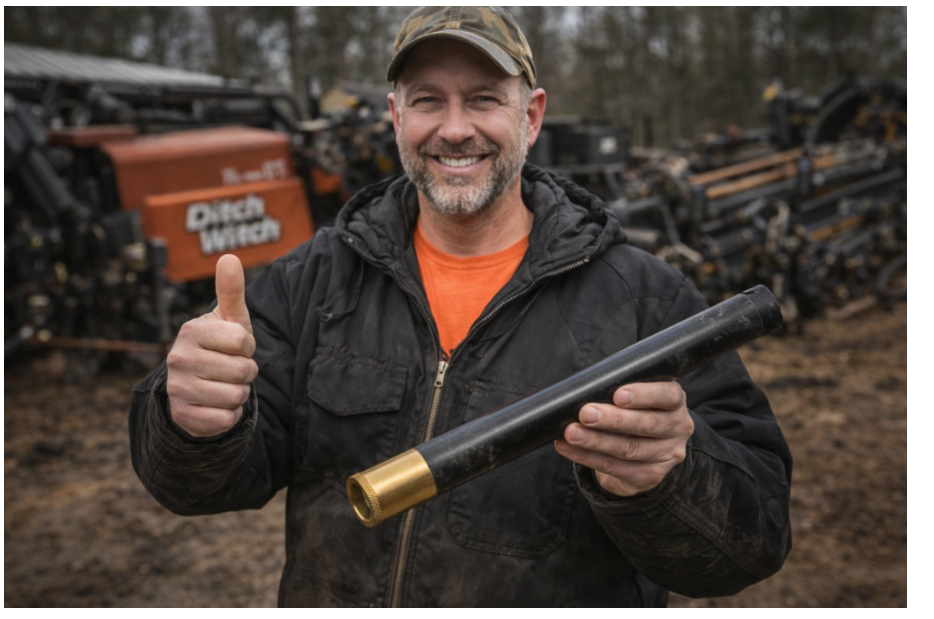
Subsite beacons look simple: a small transmitter you drop in a housing or push through a line. But the spec sheet decides whether you get a clean locate—or spend hours chasing a weak signal.
For U.S. HDD and utility crews, four specs matter most:
- Frequency
- Range
- Power
- Durability
Everything below comes from Subsite literature and manuals (and one beacon manual hosted by a Ditch Witch dealer).
Frequency: choose from what Subsite offers
Subsite’s utility locating beacons cover frequencies from 512 Hz up to 33 kHz. Within that range, Subsite lists multiple 150-series beacon options by part number at 512 Hz, 640 Hz, 29 kHz, 30 kHz, and 33 kHz.
Subsite also lists the 910B as a 512 Hz beacon. And in the same utility beacon literature, Subsite lists a B/I impact beacon at 29 kHz and 33 kHz.
For HDD guidance, some beacons offer multiple frequency modes. The 17T4/17T4G beacon manual describes the beacon as quad-frequency with 1.5 kHz, 12 kHz, 20 kHz, and 29 kHz. For a snapshot of the Ditch Witch Subsite beacons/transmitters (sondes) UCG HDD lists on one collection page, see this page.
Utility locating beacons: the frequency menu is model-specific
Subsite’s utility beacon literature doesn’t treat frequency as a vague feature. It lists specific frequencies tied to specific beacon models and part numbers. In the 150B lineup, Subsite shows multiple frequencies across short-range and long-range variants, including 512 Hz, 640 Hz, 29 kHz, 30 kHz, and 33 kHz.
The dedicated 150 beacon spec sheets support the same point. The 150 long-range beacon sheet lists the same frequency options—512 Hz, 640 Hz, 29 kHz, 30 kHz, 33 kHz—as available selections. The 150 short-range beacon sheet also lists those same options.
If you’re comparing beacons, treat frequency as a concrete spec. Subsite publishes it that way.
Range: read the “material” column, not just the headline
“Range” looks like one number until you see how Subsite publishes it. For utility locating beacons, the literature gives ranges through different materials. For HDD guidance systems, Subsite publishes depth and attaches conditions and a standards note.
In the utility beacon literature, Subsite summarizes range for the 150-series by material. For the 150 short-range water/sewer beacon, Subsite states “ranges up to 12 ft through non-metallic pipe” or 6 ft through cast-iron. For the 150 long-range water/sewer beacon, Subsite states “ranges up to 30 ft through non-metallic pipe” or 20 ft through cast-iron. For 150 conduit beacons, Subsite states long-range “ranges up to 30 ft through plastic pipe.”
On the HDD side, Subsite’s Marksman Plus literature lists Depth with normal power beacon: 70 ft (21.3 m), and it states that depth range numbers are based on SAE Standard J2520 and depend on battery type, frequency, and housing type.
Utility beacons: Subsite publishes “range in air” and “range in cast iron”
Subsite doesn’t leave “range” to guesswork. Its utility beacon literature includes a comparison table that lists “range in air” and “range in cast iron” for specific models.
In that table, the 150BW 512 Hz short-range beacon lists 12 ft (air) and 6 ft (cast iron). The 150BWL 512 Hz long-range beacon lists 30 ft (air) and 20 ft (cast iron). The 910B 512 Hz beacon lists 15 ft (air) and 10 ft (cast iron).
Those side-by-side numbers make “range” usable. They let you compare beacons without turning the spec into a sales pitch.
Power: plan around runtime, not guesses
Public spec sheets don’t always publish transmitter output power as a simple watt figure. What Subsite does publish—clearly—is battery type and battery life. That’s enough to plan the workday and to compare models on something that shows up in the field.
For utility locating beacons, Subsite’s literature lists battery type and published battery life by model. For example, it lists the 910B with (2) “AA” batteries and 6 hours of battery life. It also lists many 150-series models with their own battery and runtime entries.
The dedicated 150 spec sheets add operating conditions. The 150 long-range beacon sheet specifies one AA alkaline battery and 4–6 hours continuous use @ 70°F (21°C). The 150 short-range beacon sheet specifies one N alkaline battery and 4–6 hours continuous use @ 70°F (21°C).
For HDD guidance beacons, the Marksman Series Beacons manual publishes battery-life numbers for normal and (H) modes, and it also describes a sleep feature that reduces runtime loss when inactive.
Battery life and “(H)” mode: Subsite publishes the trade in hours
The Marksman Series manual gives you clean, quotable runtime differences between normal and (H). With an Electrochem CC lithium thionyl chloride battery, it lists 70 hours in normal mode and 30 hours (H). With a Klarus 21GT-50 lithium-ion (with adapter), it lists 23 hours in normal mode and 10 hours (H).
The same manual states that the beacon “will sleep after ten minutes of inactivity,” and it describes how to wake it: “roll slowly.” The 17T4/17T4G manual also describes a sleep feature, stating that the beacon “sleeps after 20 minutes with no roll” and wakes when rolled.
If you want one simple takeaway grounded in the manuals: Subsite publishes different battery-life numbers for normal and (H) modes, and it publishes sleep behavior that affects how long a beacon runs when inactive.
Durability: IP rating and temperature limits decide the failure point
Durability isn’t a slogan. Subsite publishes two durability anchors you can use: IP rating and operating temperature range. The manuals also spell out what actually kills beacons.
For HDD beacons, the Marksman Series manual lists IP67 and an operating temperature range of -4° to 221°F (-20° to 105°C). The 17T4/17T4G manual also lists IP67 and the same operating temperature range: -4° to 221°F (-20° to 105°C).
For utility locating beacons, Subsite’s 150 beacon sheets publish a different temperature ceiling. The 150 long-range beacon sheet lists an operating temperature range of -4°F (-20°C) to 122°F (50°C). The 150 short-range beacon sheet lists the same operating range: -4°F (-20°C) to 122°F (50°C).
The most direct durability statement comes from Subsite’s Marksman Series manual: “High temperature is the primary cause of beacon failure.”
Heat: Subsite calls it the primary cause of beacon failure
Subsite’s Marksman Series manual doesn’t hedge: “High temperature is the primary cause of beacon failure.” It also publishes hard limits and job guidance around heat.
The manual lists an operating temperature range of -4° to 221°F (-20° to 105°C). It warns that operating above 221°F (105°C) can overheat the beacon and void warranty. It also states that if temperature goes above 161°F (72°C), the tracker alarm sounds and the manual provides steps to cool the beacon (including stopping drilling, pulling back, and pumping fluid).
Those lines belong in any durability discussion because they connect the rating to what crews see: heat rises, alarms sound, and the manual tells you what to do next.
Quick spec checklist (what to compare before you buy)
| Spec | What to look for | Source-backed examples |
| Frequency | Published operating frequency options by model | Utility beacons offered from 512 Hz up to 33 kHz; 150 long-range options include 512 Hz, 640 Hz, 29 kHz, 30 kHz, 33 kHz; 17T4/17T4G quad-frequency 1.5 kHz, 12 kHz, 20 kHz, 29 kHz |
| Range | Utility: feet in air and cast iron. HDD: published depth with stated caveats. | 150 short-range: 12 ft (air) / 6 ft (cast iron); Marksman Plus: 70 ft (21.3 m) depth with normal power beacon and J2520 note |
| Power | Battery type and published battery life; normal vs (H) runtime | Marksman Series battery life: 70h normal / 30h (H) (Electrochem CC) and 23h normal / 10h (H) (Klarus 21GT-50); 150 long-range: 4–6h continuous @ 70°F |
| Durability | IP rating and operating temperature range | Marksman Series IP67, -4° to 221°F (-20° to 105°C); 150 beacons -4°F (-20°C) to 122°F (50°C) |
What this means for HDD and utility contractors
Subsite publishes frequency choices, range numbers by material, runtime by battery and mode, and durability limits by rating and temperature. Use those specs the same way Subsite prints them: as constraints.
- Start with frequency as published for the beacon model.
- Treat range as a material-based number for utility beacons and a standards-bound depth number for HDD guidance.
- Use battery life to plan the day, and read normal vs (H) runtime as a published trade in hours.
- Take temperature seriously. Subsite calls it the primary cause of beacon failure and publishes thresholds and guidance around it.